This month: 1) one for the history books, 2) my musical chronology advances by yet another decade, and 3) is it art?
The footnotes are back.
Baptist Church Cemetery plaque unveiling
My good friend Greg Wilkinson recently concluded a side project that started with a talk by a local historian. Greg didn’t believe the speaker when he mentioned an old cemetery located near Greg’s house, but a subsequent site visit confirmed that there was in fact a cemetery, completely overgrown, and exactly where the historian said it should be. Greg organized volunteers to clear the cemetery, and convinced the City of Toronto to install a historical plaque. He wrote the following description of the official unveiling:
19 July 2025
The Baptist Church Cemetery on York Mills Road east of Yonge St. was the location of many community gatherings before the church was demolished and the Cemetery closed after World War II, but rarely if ever since 1945. However, on July 19, 2025, a crowd of more than fifty community members, dignitaries and families of the departed gathered in the cemetery on a warm, sunny morning under the soaring maple canopy to witness the unveiling of a new Heritage Toronto plaque and an inviting bench. The plaque tells the story of the Church, parsonage and cemetery, and some of the notable people buried there.
York Mills Baptist Church was once at the heart of the historic York Mills village community. A small wooden church stood west of here from 1832 to 1949 and the parsonage is still located to the east. This cemetery was located between the two buildings and accepted burials until 1945. The church congregation was small, at one time consisting of only six members, resulting in the nickname “The Church of the Six Sisters.” Several timber beams from the old church were saved and used in the ceiling of the nearby St. John’s Anglican Church. The burial ground contains 38 grave markers, the oldest dating to 1832. Among the notable burials here are Rev. James Mitchel, the first pastor of the church; Ezekiel Gooderham, pastor from 1849 to 1864, and his wife Harriet Juby; other members of the famous Gooderham distilling family; and Sapper Morden Jay Fulton, who was a casualty of the First World War.
A brief ceremony preceded the unveiling of the plaque with community member Greg Wilkinson describing the colonial and early Canadian era represented by many of the markers in the cemetery, with the context of the cemetery being on the traditional lands of many Indigenous peoples. The crowd heard remarks from several speakers 1 who recognized the contributions of many volunteers and particularly cited the Gooderham family.2 Community and family connections were forged and revived at the event.
As a result of the efforts of many volunteers and donors, the cemetery is now a welcoming grove with an informative plaque that will provide a glimpse into the people and stories that are part of our community history in a place to wander and sit for moments of peace and contemplation.

Music Recommendation from the 2000s
After Y2K, we renovated our Oakville house, and installed a pool. It was a great spot, in a quiet neighbourhood, close to Lake Ontario. We made great friends and planned to stay forever. I think that is called foreshadowing.
It was during this time that iTunes allowed you to “Rip and Burn” music to CD, and with Napster and Limewire you could find music for “free” out on the internets. This led me down quite a lot of rabbit holes3. E.g. I downloaded many versions of the same song, as many as I could find, and burned them to a CD. So if you came to our place for dinner, you might have been listening to 10 or more renditions of “The Girl from Ipanema”, “Stardust”, or “Falling in Love Again” over and over and over.
Other musicians were creating works of more lasting value. Any of half a dozen Bill Frisell releases, for example. Or Max Richter’s beautiful composition “The Blue Notebooks”, which I guarantee has played in the background in many movies that you have seen.
But I think my pick of albums from the 2000s would be “Insen” by Alva Noto & Ryuichi Sakamoto. Alva Noto (stage name of Carsten Nicolai) creates completely electronic work of precise clicks, beeps, and blips. Sakamoto is a very spare pianist. Together they created magic.
Dry Stone
I am always impressed, when visiting foreign soils, by the extensive network of stone walls delineating old farm fields. No concrete or cement is used, yet these wall are nearly perfectly straight and last for hundreds of years. The builders probably thought of their efforts in purely practical terms, marking boundaries and clearing fields for crops, but in the process they produced something of lasting beauty.
Today, not many have the skills needed to build a dry stone wall, and there are faster and cheaper alternatives.
At the Storm King Art Center in New Jersey, British artist Andy Goldsworthy is keeping the tradition alive. He has completed 2 drystone walls as art installations: one in 1998 and another in 2010. In part, the walls were built over previous walls so, when I visited several years ago, it wasn’t immediately obvious whether Goldsworthy’s work were functional walls, or art, or a bit of both. But in other sections, they definitely curve more than most.
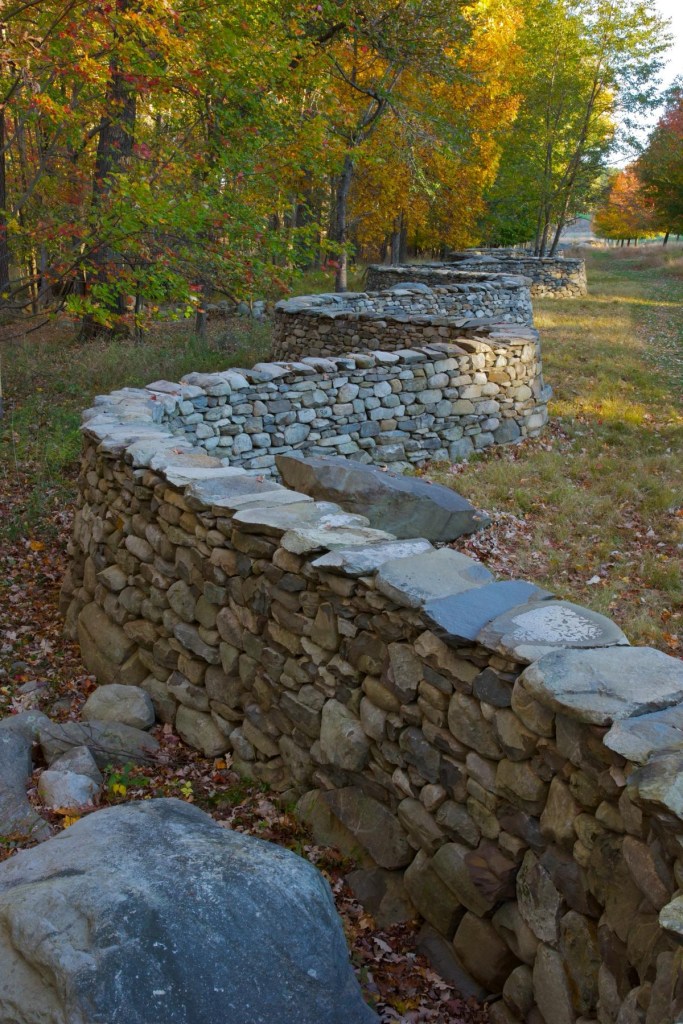
Either way, it’s an interesting example of finding art in unexpected places. Richard Williamson suggests 3 dimensions for thinking about art: novelty, nuance and narrative. I think these walls are strong on each.
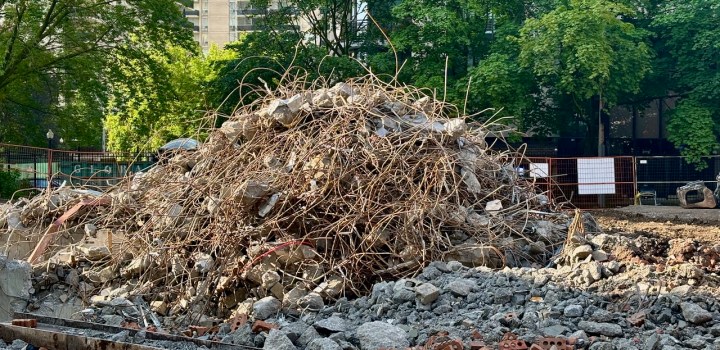
PS: the header image this month is a pile of junk that I pass by on my morning walks. It used to be a small office building, but is being turned into a 54 floor condo building. You know, progress.
- Meg Sutton of Heritage Toronto, Jane Stephens of the St. Andrews Ratepayers Association, Councillor Rachel Chernos Lin, and Koon Leung of the Canadian Baptists of Ontario and Quebec, Glenn Bonnetta of the North York Historical Association, Pat Barnett of the East York Historical Association, local historian and author Scott Kennedy and sixteen members of the Gooderham family.
↩︎ - Led by Helen Gooderham-Sutton who were primary donors for both the plaque and the bench, which has a specific dedication to Pastor Ezekiel Gooderham and his wife Harriet.
↩︎
