
It’s the 2025 Winter Solstice1 edition of 3 Things. Grab a blanket and a wee dram, it’s cold and dark out there.
This month’s features include: 1) a (not completely made-up) story 2) another evil Xmas poem2, and 3) microscopic transportation.
This is as true as I could make it…
Boomtown3
In early 1851, Queen Victoria was getting ready for the opening of the Great Exhibition at Crystal Palace in Hyde Park, which everyone hoped would buoy the spirits of the British people. The previous decade had been hard for everyone in the Isles, but crop failures and potato blight in Ireland and Scotland had been devastating. Yet in the Vale of Leven, between Loch Lomond and the River Clyde, there was hope. The village of Bonhill was flourishing. It had become the Scottish epicentre of the calico printing business due to local expertise with the very tricky process of manufacturing Turkey Red, a bright and coloutfast dye ideally suited for cotton.
Now, don’t get the wrong impression. Life in Bonhill was grim. Even those with jobs were living a life we would consider intolerable. Typically, 2 or 3 generations would share a couple of rooms in a house, which was itself shared among several families. There was no plumbing. Dismal as it was, it was better than the alternatives, particularly Glasgow which was becoming a synonym for urban blight and decay.
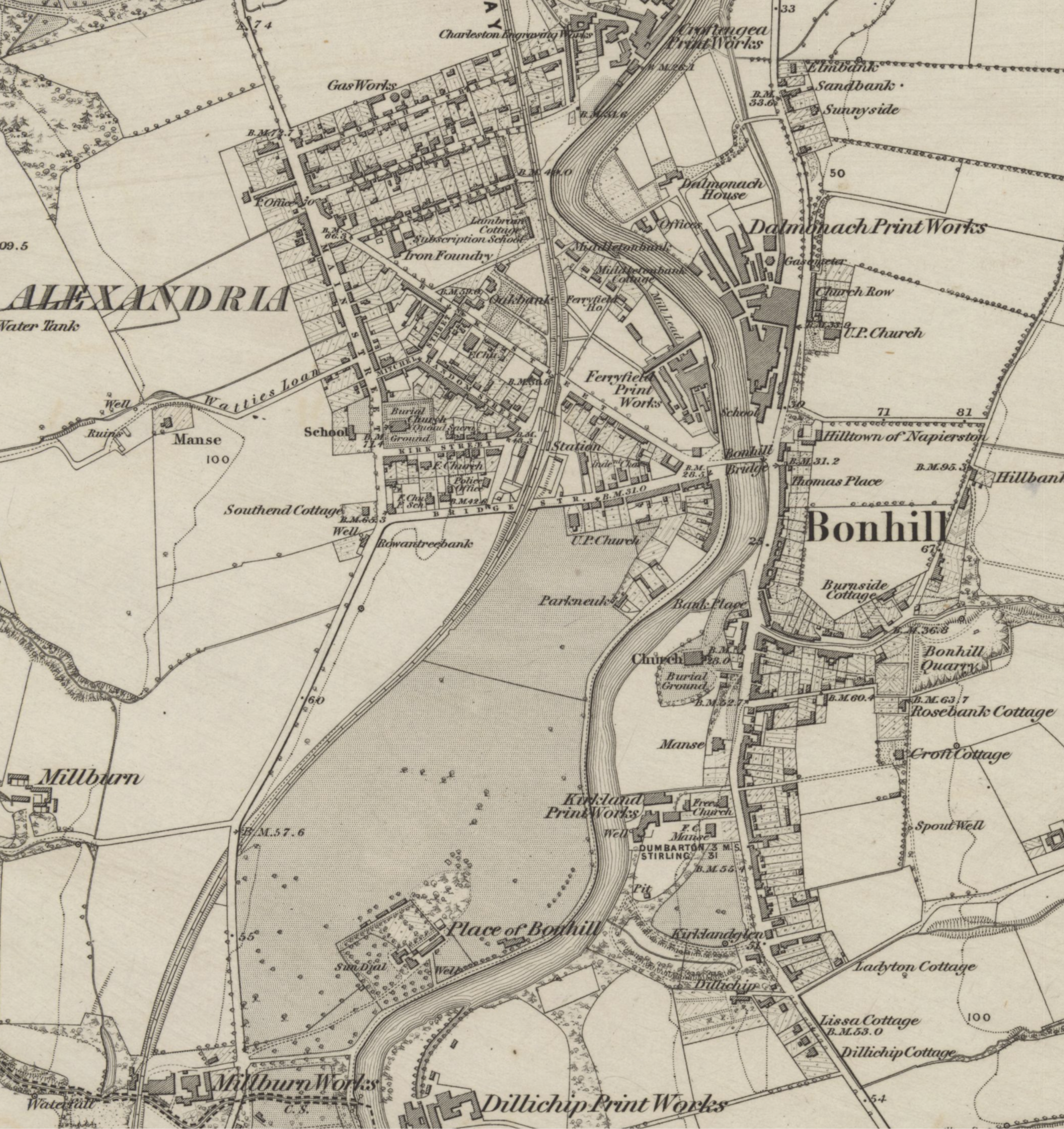
A branch of the Brannan family lived in Bonhill. Like thousand of others, they came to find work. But this isn’t a story about the Brannans, at least not yet. This is a story about a bairn or wean from Glasgow.
Let’s start with John Brodley and his new wife, Isabella. They were married on 19 April 1851 and had a daughter, Eliza, a few years later. John’s family was from Dumbarton, but he had moved to Bonhill to work as a calico block printer and to be with Isabella. They lived with her aging father and her son, whose father was long gone. The boy, Archie Campbell, was just 14 but already working in the dye-works. Although money was scarce, they survived by renting out most of the rooms in her father’s house to another family.
As the years passed, John couldn’t say that he was unhappy. He’d spent a decade in the Bonhill printworks and, yes, it was a hard life, the hours long and the pay meager, but it had mostly been steady. He loved Isabella and their daughter was able to attend the factory school. They were getting by.
Introducing the Elizabeths Aimer
In 1861, John got a message from Glasgow. A widow there, Elizabeth Aimer, had a newborn daughter, also called Elizabeth, and she said that John needed to come and take care of her. The woman’s husband had died, leaving her to care for their 4 children on her own. It’s not surprising that she couldn’t handle a fifth. So he talked to his wife, who agreed that Glasgow was no place for a child4, and little Elizabeth Aimer started a new life in Bonhill.5 At least with the Bradleys she stood a chance of surviving.
Why did the woman from Glasgow get in touch with John, and why did he agree to take the baby into his household? Was he the father? It is impossible to say for sure, but I don’t think so. When the census taker called years later, they said the child was a boarder. Given that Isabella felt no need to disguise the fact that Archibald, was her son, even though she wasn’t married when he was born and the father had abandoned them, it would be strange to hide the identity of John’s daughter, if it were true.
Regardless of the reason for bringing the baby to Bonhill, it seems that little Elizabeth not only survived but spent her childhood as a loved member of the Bradley household. The two other children, Archie and Eliza, both worked in the factories, and Elizabeth Aimer was able to go to the factory school
Unfortunately, it didn’t last; sometime in the 1870s, when Elizabeth Aimer was a teenager, the family’s fortunes changed. Isabella died, possibly during one of the frequent outbreaks of typhoid or cholera. Her daughter Eliza and son Archie just seem to vanish from the records. Maybe suffering the same fate. John and Elizabeth Aimer were now alone.
Still, John had done what he promised; he had protected Elizabeth Aimer. By her 20th birthday, people had forgotten, or no longer cared about, her birth family and John started telling people that she was his daughter. Whether she had been formally adopted or not, she began calling herself Elizabeth Bradley.
Then Thomas Branan (sic) and his family moved into the same house on Croft Lane where John and Elizabeth were living. Now a young woman, Elizabeth Aimer Bradley’s life was about to change again.
— More to come —
Innocent’s Song
Who’s that knocking on the window,
Who’s that standing at the door,
What are all those presents
Lying on the kitchen floor?
Who is the smiling stranger
With hair as white as gin,
What is he doing with the children
And who could have let him in?
Why has he rubies on his fingers,
A cold, cold crown on his head,
Why, when he caws his carol,
Does the salty snow run red?
Why does he ferry my fireside
As a spider on a thread,
His fingers made of fuses
And his tongue of gingerbread?
Why does the world before him
Melt in a million suns,
Why do his yellow, yearning eyes
Burn like saffron buns?
Watch where he comes walking
Out of the Christmas flame,
Dancing, double-talking:
Herod is his name.
Charles Causley 6
I saw into the future…
In Siracusa, Sicily these little things7 are everywhere. Technically, they aren’t cars at all: They are quadricycles so you don’t need a driver’s license to get behind the wheel.
And they are tiny. Park them anywhere. There’s room for two and your stuff (within reason).
And cute? That doesn’t start to describe it.
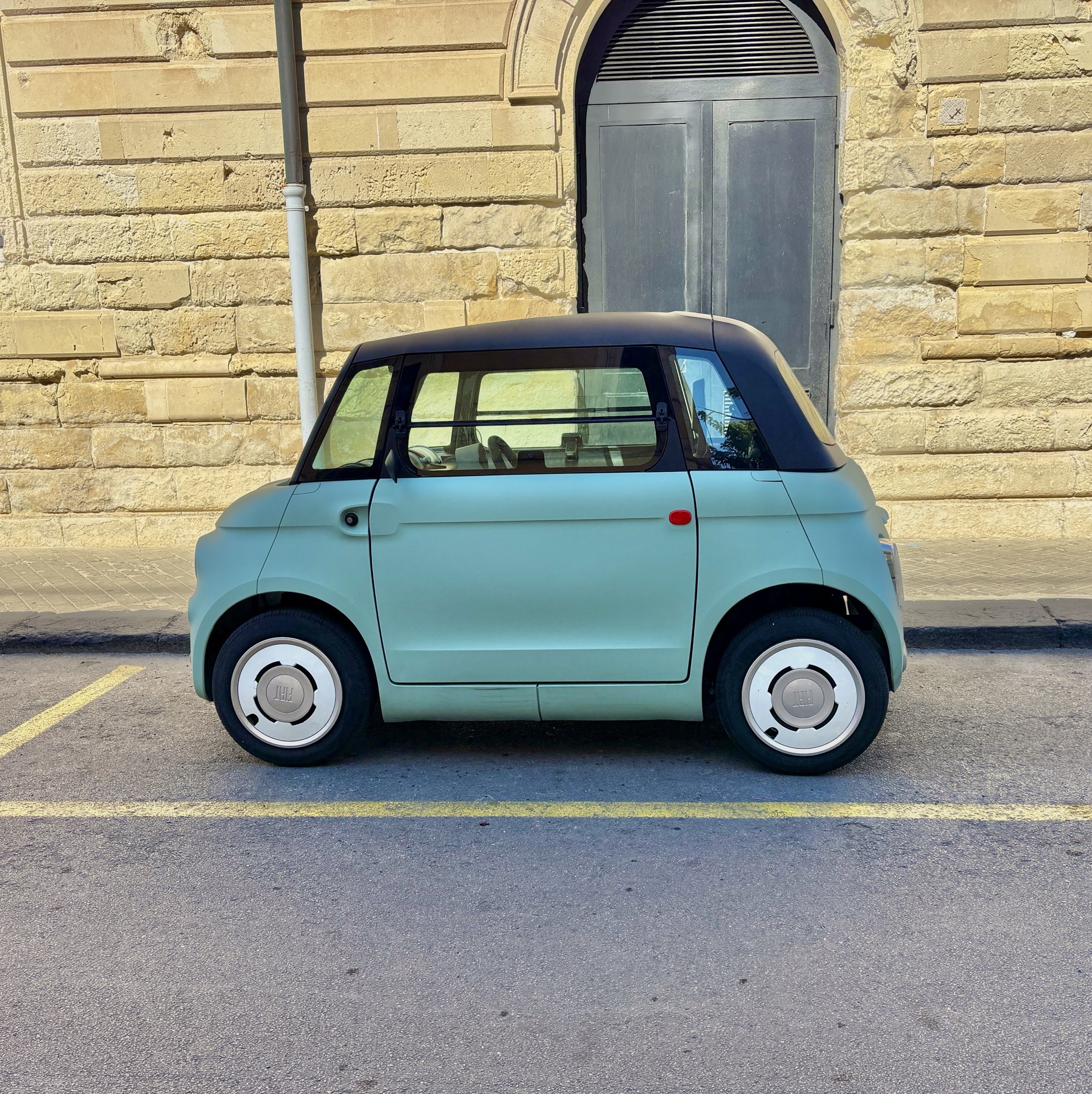
I think they could really take off.
PS: the header image this month shows Burn Street in Bonhill. It’s a street with a burn, or stream, running through it. It might include the house where the Brannan family once lived.
- Last year I told you about the Gävle Goat and its battle for survival. Well, it has started again. Follow along on the official Gävle Goat page. ↩︎
- The first one was: https://brannan.org/2024/12/01/3-things-in-november/#EvilXmas2024 ↩︎
- I had a strong urge to call the section “MacBoomtown”, but was able to resist the temptation. I hope you appreciate my restraint. ↩︎
- Elizabeth and George Aimer lived on Coburg St in the Gorbals section of Glasgow, south of the River Clyde. I’m not sure what life was like when they arrived, but when Elizabeth Aimer was born in 1861, it was probably squalid. Attempts to develop an upscale residential neighbourhood in the early 19th Century had failed and the area became known for overcrowded slum tenements. Life would have been bleak; disease, crime, filth and poverty were rampant. There are some pictures of just how horrible it might have been at this link:
https://flashbak.com/thomas-annans-powerful-photographs-of-the-old-closes-and-streets-of-glasgow-1868-426273/ ↩︎ - It isn’t clear what happened to the widow Aimer after she gave up her child. We know that her oldest son, John, was married in 1867 and then moved to Manchester with his younger brother, George, for a while. Perhaps this was because work in the Scottish printworks dwindled in the 1860s when the northern US states’ blockaded cotton exports from the rebellious south. Maybe their mother went with them, continuing to care for her two youngest. Or perhaps she remarried and took another name. Or maybe something else. John, returned to Glasgow, but succumbed to tuberculosis in 1877. His mother was still alive at the time, but had passed away by the time her youngest son James died of liver cancer in 1910. George emigrated to the US, and lived until 1915, when he passed away in Michigan. ↩︎
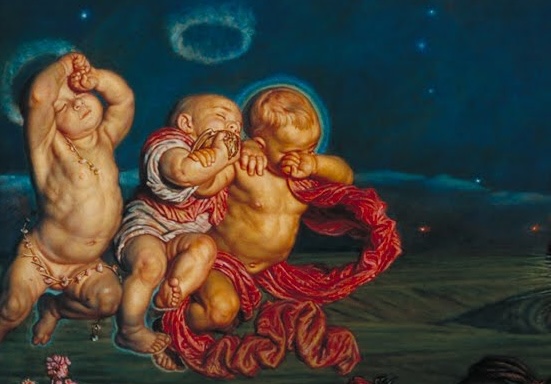
- Charles Causley (24 August 1917 – 4 November 2003) was a Cornish poet, schoolmaster and writer. His work is noted for its simplicity and directness and for its associations with folklore, especially when linked to his native Cornwall. The image of the infants is a snippet from William Holman’s The Triumph of the Innocents ↩︎
- The picture shows the Fiat version, but it was originally released as the Citroën Ami, and Opel also makes a version. ↩︎


Look forward to reading the rest of the Bradley story. Basis of a Script for a TV series?Sent from my iPad
Thanks Tony. I’m glad you enjoyed. I paid a small fortune to the Scottish records office to research it.
Hi Stuart,
Life was very bad in a great part of Europe at that time. This picture I saw in Leiden last week I was there. Did me think one of your 3 thoughts in December.