
This month: 1) a death 2) an ænigma, and 3) Spotify sux.
Those of you waiting for me to reveal the greatest music from the 2010s are just going to have to wait.
Sheila Jordan (1928 – 2025)
In 1979, I worked a summer job in Edmonton, and shared a small apartment with PA, and MDC, and sometimes CL. It was in a student residence built around a long glass-covered retail mall, and at the end there was a record store1. Once, when I was killing time browsing the store, the staff were playing “Sheila”, a newly released2 collaboration between Sheila Jordan and Arild Anderson. I loved the spare sound of Jordan’s vocals combined with Anderson’s upright bass. I’d never heard anything like it3. The record included expressive interpretations of jazz standards, like “Lush Life”, “On Green Dolphin Street”, “Better Than Anything”4 and “Don’t Explain”. But, maybe even better, it included recent compositions like “Song of Joy”5 and especially a couple of Steve Kuhn compositions (more about that in this month’s other things below).
I overheard the clerk talking to someone (another customer?) saying that he had a friend who wasn’t impressed with the album, but he (the clerk) thought it was “Art”. I bought the record, and for nearly 50 years, I have agreed with him6.
According to Wikipedia:
Sheila Jeannette Jordan was an American jazz singer and songwriter. She recorded as a session musician with an array of critically acclaimed artists in addition to recording her own albums. Jordan pioneered a bebop and scat jazz singing style, with an upright bass as the only accompaniment.[1] Jordan’s music has earned praise from many critics, particularly for her ability to improvise lyrics…
Over the years, I followed her recordings and saw her perform on several occasions, starting in the late 80s or early 90s. Unsurprisingly, her voice and tonal range were never quite a clean as on that 1978 recording, but it wasn’t the purity of her vocals that I loved. It was her way of placing her own emotional stamp on whatever she sang, whether it was a standard or a contemporary piece.
Here are a couple of pictures from a performance HVW and I attended in NYC in 2019 :
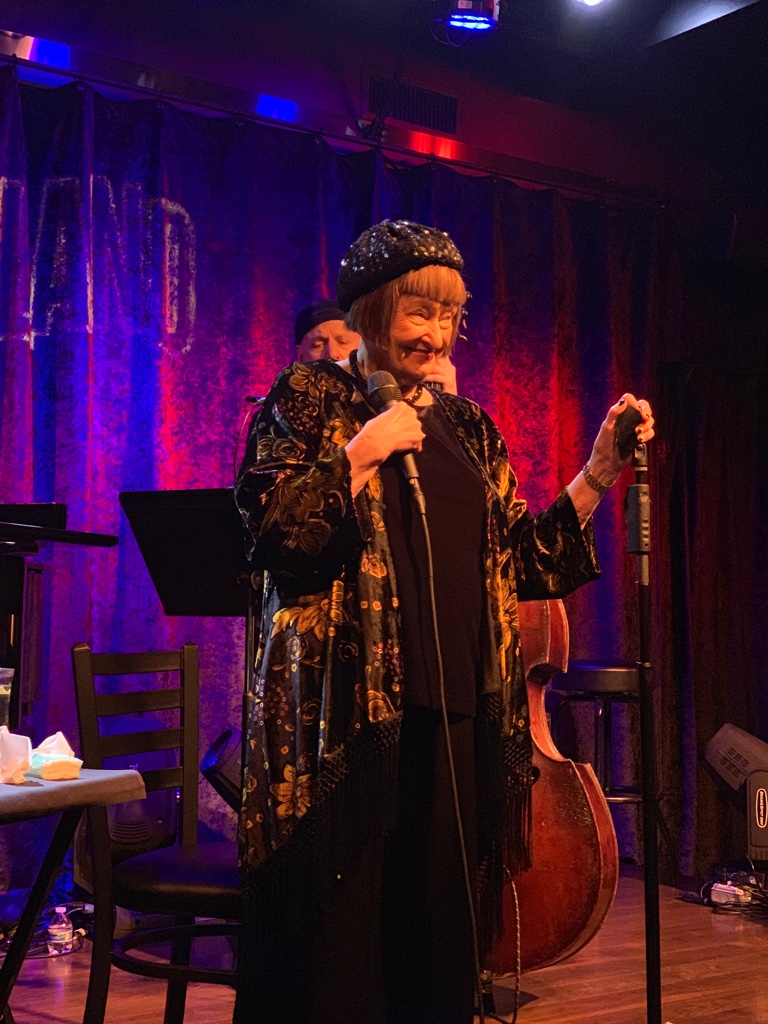

Jordan was very comfortable on stage, and seemed like a genuinely decent human being.
The last time I saw her sing was in the summer of 2023 at Mezzrow, a tiny club in Greenwich Village. During a break she wandered back to the bar and found someone she recognized, brought him to the stage and introduced him as pianist Alan Broadbent, with whom she had made a couple of records in the 1990s. They shared the stage for a song, and it was a pure delight.
Sheila Jordan died on 11 August 2025.
What’s it all about?
At several times in her career, Sheila Jordan collaborated with Steve Kuhn (an American jazz pianist, composer, arranger, and bandleader). She included his song “The Saga of Harrison Crabfeathers” on her 1978 album “Sheila”. It wasn’t the first recording of the song. That honour goes to Monica Zetterlund, who recorded it in 1972, just a decade after she had placed dead last when representing Sweden in the 1963 Eurovision song contest.
Jordan’s version was one of my favourites from the album, despite the enigmatic and incredibly sad lyrics:
Now and then I think of when his teeth were so small and white
He laughed when he heard the songs in the distant night
Later on his smile was gone, his lips spoke of silent things
The least he could do was more than his life could bring
Oh what a shame, what a terrible shame
To be lost and found below the ground, beneath every child that plays
His life was so short, it’s hard to believe today.
Something very personal is being revealed here. What that is, isn’t exactly clear. Many people speculated that it was about the death of a child, but Kuhn never confirmed that. And in 2004, Sheila Jordan said that Kuhn had just liked the sound of the name “Harrison Crabfeathers”, which he had seen in an ad for a piano player looking for work in Down Beat magazine.
But the identify of Crabfeathers is only part of the enigma, and Jordan’s explanation is far from satisfying.
In 1979, Kuhn and Jordan recorded an album together, called “Playground”, which included a track called “Poem for No. 15”. Here’s the strange thing: “The Saga of Harrison Crabfeathers” and “Poem for No. 15” are the same song.
Now, at some point7, HVW and I saw Kuhn and Jordan perform together and they played “Poem for No. 15”. In his introduction, Kuhn said that it was dedicated to NY Yankees baseball great Thurman Munson, who died on 2 Aug 1979 in a crash while landing his Cessna jet in Akron OH. The Yankees immediately retired his uniform No. 15. Kuhn didn’t mention the song’s previous “Crabfeathers” incarnation, nor its mysterious eponym.
I guess there is nothing wrong, with re-purposing one of your compositions. I still love it.
But the whole song seems to be wrapped in mystery: was Harrison Crabfeathers really just a nifty name? who do the lyrics, which were written years before Munson’s death, refer to?
If anyone reading this has the answer, please let me know.
But wait, there’s more
“The Saga of Harrison Crabfeathers” is now considered a jazz standard, having been recorded by many, many artists. Not surprisingly, it is also one of millions of songs that various algorithms add to playlists on Spotify and other streaming services.
The streaming services, and music distributors (like Sony, Universal etc.) figured out that they could increase their profits by paying session musicians a fixed fee to record bland, inoffensive versions of these standards. These songs are then streamed thousands of times or more as they show up on multiple playlists and most people aren’t paying that much attention to know that they are listening to a generic knock-off of a popular song. This is highly profitable to the streaming companies and the music distributors because they don’t have to pay the performers for each play.
This is explained on a blog called “Beautiful Song of the Week” when Crabfeathers was featured in April 2017. The author was trying to find information about an instumental recording of Crabfeathers by “Milos Foreman”, only to conclude that it was one of several fake names used for recordings by contract musicians. Curiously, the author enjoyed the Milos Foreman version more than the other recordings by “real” artists.
I don’t agree. In my opinion, either of the Sheila Jordan versions are far superior, but that doesn’t make them wrong. And as the author points out, the Milos recording was made by real musicians with real instruments, and whether they are getting a fair payment from the streaming companies is artistically irrelevant.
PS: the header image this month is from the Scapa Distillery in Orkney. I’m not very knowledgeable about whiskey, but this was pretty, pretty good.
- Remember record stores? I do. I spent a lot of time in them, once upon a time. ↩︎
- Actually it had been released the previous year, but in those days it took a while for things to make it all the way northern Alberta. Sometimes when they arrived, the locals didn’t know what to make of them. In the previous year I had worked in northern Saskatchewan, and found records by the Sex Pistols and Elvis Costello in the comedy section. True story. ↩︎
- To this day, the upright or double bass is my favourite jazz instrument. Something that HVW was surprised to learn only a couple of years ago when I was less than impressed by a quite famous saxophone-centric performance at the Village Vanguard. ↩︎
- The lyrics to this song are infuriating. The title refers to “something”, and the lyrics list many other things that that “something” is better than: sailing at midnight, diving for pearls, being spotted in a crowd and so on. But that something is not better than being in love. So what is it? What is “better than anything thought of / better than anything said”, but not better than being in love? I’m stumped. ↩︎
- “Song of Joy” was written by Billy Preston and the mysterious Rasputin Boutte, and had been recorded a couple of years earlier by that famous jazz duet: Captain and Tennille. Jordan’s version is far better IMHO. ↩︎
- If you are one of the (very) few regular readers of these updates, you might be saying to yourself, “If Sheila is so great, how come she wasn’t on your list of best music from previous decades? What’s up with that?”. I wouldn’t blame you because, that, as they say, is an excellent question, which usually means that there is no good answer, What can I say, this isn’t an exact science. ↩︎
- I don’t recall exactly when, maybe late 90s. ↩︎
