Many people1 have asked what I am trying to achieve with this “3 Things” project. My response is that it would be nice, although the probability is zero, if someday in the future, someone somewhere might read these and say about me what Charles Nicholl said about 17th Century writer, John Aubrey:
The range of his interests defies classification – biographer, topographer, antiquary, mathematician, folklorist, archaeologist: the list could go on. He is sometimes described as a ‘miscellanist, a term redolent of a bygone age of genial scholarly browsing. …. Contemporaries described him variously as a ‘learned honest gentleman’, a ‘professed virtuoso, always replete with new discoveries’ and a ‘shiftless person, roving and maggoty-headed’.2
I’d prefer not be known as shiftless or maggoty-headed, but I’ll take what I can get.
This month: 1) at last, the much delayed big reveal: my favourite music from the 2010s, 2) me overthinking rock concerts, and 3) some photographic detective work.
The Greatest Music from 2010s
A lot of things changed for HVW and me in the 2010s. We sold our Oakville house, purged much of the baggage that we had accumulated, and set up camp in Hoboken NJ. Moving from the burbs in Canada to the city in the US was a huge and hugely positive change. No regrets.
Here is some music from that time that made a lasting impression:
- El Bronx is a Los Angeles punk band, but periodically they release albums under the alter ego of Mariachi El Bronx. I have no idea if they are any good at punk, but they are a phenomenal mariachi band. Pure fun.
- Martin Nonstatic3 released Granite in 2015 around the same time as I lost my job at CIBC. It got me through some uncertain times. His music is described as “smooth catchy drifts, hypnotic melodies and waves of subtle beats that contrast with lush soundscapes”4, which honestly is just gibberish, but somehow I found it comforting.
- Loscil5 is a Canadian electronic musician based in Vancouver. In the early 2010s he released a couple of albums that really resonated with me: Endless Falls and Coast | Range | Arc.
And now, the moment you have all been waiting for: The best music of the 2010s, according to me, is….
Nils Frahm6 is the wunderkind of the neo-classical/ambient music world, but he is hardly a household name. I think his best work is Felt, and it was among my list of favourites for 2012. It is low-key, quiet, mostly piano, dampened with felt7 to avoid disturbing his neighbours during late night recording sessions, but augmented with subtle electronics. It comes together beautifully IMHO.
Here is a live performance of “Says”, which is his most popular work, and it is quite a bit livelier than Felt. I have no idea what he is doing most of the time, fiddling with knobs and moving levers more than playing a traditional keyboard, but when HVW and I first saw him perform, she turned to me at the end and said “That was amazing!”.
Collective Effervescence or What I Have Against Rock Concerts
Most people not named Glenn Gould enjoy going to see live music. I include myself among them, but I have to make a confession. Although I try to be thoughtful and open in my approach to music, and although I love live performances, going to rock concerts annoys me. I know, many of you will disagree with me, but I have three reasons for this. Let me explain.
Reason #1: Being in the audience vs being part of the experience.
If you attend a classical music performance, you sit and listen, appreciatively, until the end, and then clap. Maybe you shout “bravo”, and probably you stand to show your appreciation. God help you if you do any of these before the actual end, say between “movements”. If you go to see a jazz musician, you sit and listen, appreciatively, until the end, and then clap. During the performance you clap at the end of each “solo”. At the end of the evening you clap and stand to initiate the encore ritual, where musicians come back on stage and perform another tune, pretending that it wasn’t part of the plan. In both cases there is a pretty clear line between the performer and the audience.
At a rock concert, particularly in large venues, the expectation is that you will be in some sort of ecstatic emotional high for the duration of the show. Maybe standing for large parts of the show, singing, or at least clapping, along with the “hits”, and generally feeling like the performer and audience are participating more or less equally in the moment. There is also a bit of a competition at the start of each song, to see who can recognize the melody first and shout “Yeah!!”, before anyone else.
This is what distinguishes the the rock concert experience from other live musical performances: the audience has an active role in the show and, sorry, but that’s not for me. I don’t want to heap adulation on the performer just because they are playing a tune that I, and everyone else, happen to like; even if it is a tune that was part of the soundtrack to my younger years. I want to be entertained, not to be part of the experience. The whole thing reeks of forced rituals: stand up, sit down, sing along, clap.
Some people, lots of people apparently, enjoy this kind of thing. Whether they know it or not, they are, I think, seeking a sense of ecstasy from dissolving their individual selves into a crowd, what Nietzsche called “the blissful rapture that rises up from the innermost depths of men”8. Emil Durkheim called it “collective effervescence”9. It is akin to the experiences of evangelical christian churches which are mostly harmless, but such emotions can be exploited for evil purposes (see, for example. the Nuremberg rallies). Of course, rock music and totalitarianism are antithetical in many ways, but they both exploit the same human emotions.
Reason #2: The venues.
When I was young, going to rock concerts in huge arenas was just what you did. You’d sit far, far away from the stage, barely able to see the artists. Eventually, I tired of paying big bucks to see nothing. It was a soulless experience, for me: YMMV. Note: as the technology improved, on stage screens magnified the musicians such that anyone in the back could see the action. But if you are going to watch the performance on a screen, why even go to the show?
Reason #3: I don’t want to be the guy trying to relive his glory years.
This doesn’t apply to all rock concerts, but I was reminded of this when 79 year-old Neil Young made a tour stop in Toronto. I imagine it to be full of (mostly) guys who are (mostly) in their 60s and 70s, and who, whether they admit it or not, are reliving the happiness they felt listening to Neil Young in their youth. The curmudgeon in me says: let it go, move on, try something new. Sorry, but that’s how I feel.
The Time Machine
In the early 1980s I went on a road trip to NYC and took some photos. I always liked this one, taken somewhere in lower Manhattan late on a hot summer Sunday afternoon. The city had gone through a rough time in the 70s, and although crime and safety had started to improve when I visited, living there would have been a decidedly mixed experience. So this shot of young New Yorkers, all skinny white guys, enjoying an impromptu volleyball game on the streets seemed really, really cool to me.
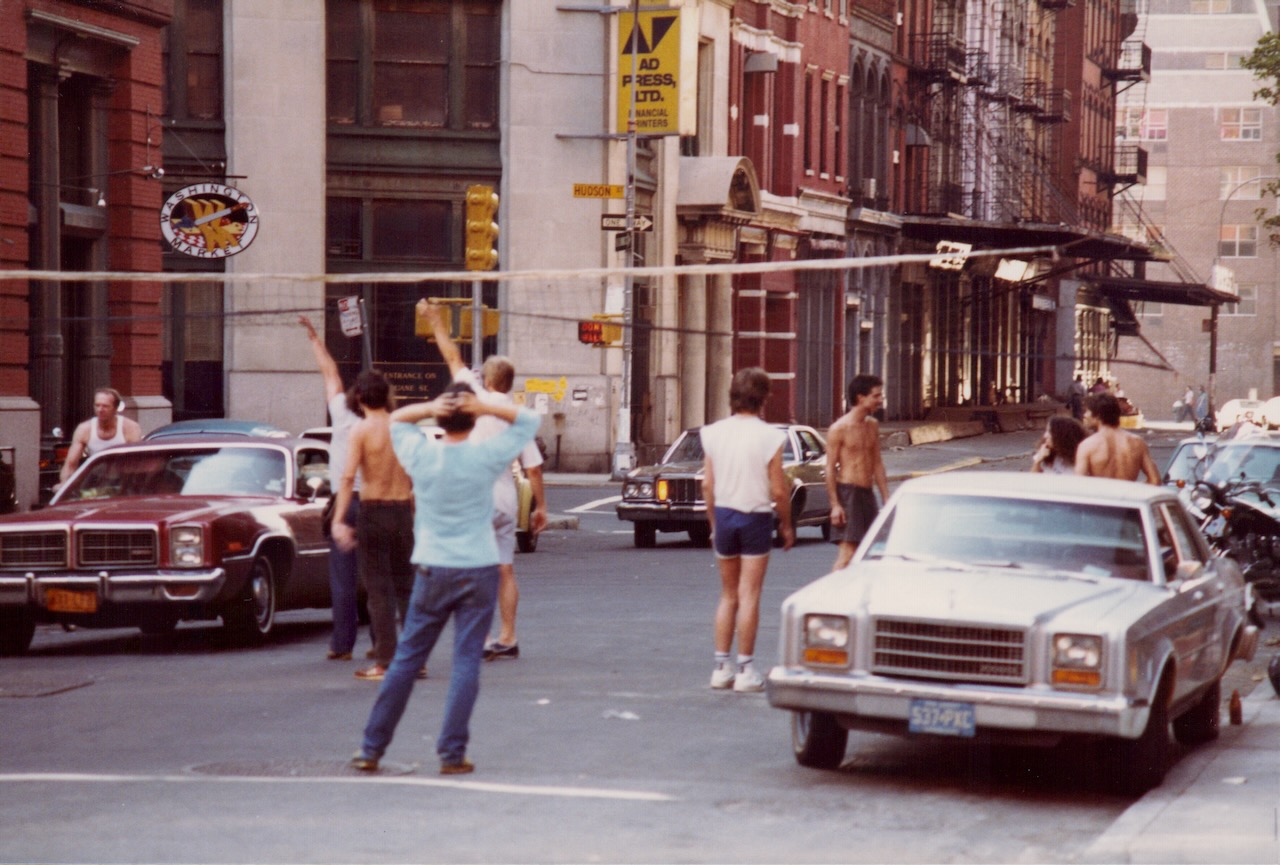
Recently I decided to see if I could figure our exactly where the shot was taken, and what the area looked like today. Through the magic of Google Street View, I managed to pinpoint it as the corner of Hudson and Duane, in Tribeca. Here is what it looked like recently.

Maybe surprising, given the amount of development that NYC has gone through in the past 40 years, but the buildings are identical. The street is still cluttered with cars, and in the more recent shot you can see garbage10 piled on the sidewalk, which is one of the most New York things ever. Sadly, it doesn’t look like a place where people string up volleyball nets on the weekend anymore.
Call me a sentimental fool11 if you want, but 1980s Tribeca looks like it would have been much more interesting place to live.
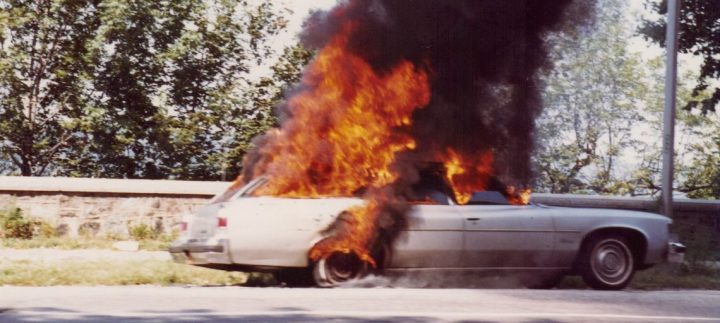
PS: the header image this month was taken in NYC on the same trip as the street volleyball shot. Just a random station wagon burning at the side of the road. As I said above, living there at that time would have been a mixed experience.
- Actually nobody has asked, but I often ask myself. ↩︎
- “Noticing Everything, A Celebration of John Aubrey” in Nicholl, Charles. Traces Remain: Essays and Explorations. Penguin UK, 2011. ↩︎
- Real name: Martin Van Rossum ↩︎
- https://ultimae.com/product/martin-nonstatic-granite-ultimae-cd/ ↩︎
- Real name: Scott Morgan ↩︎
- Real name: Nils Frahm ↩︎
- Hence the album title. Duh! ↩︎
- Hausmann, Wm A., and Friedrich Wilhelm Nietzsche. The Birth of Tragedy; or Hellenism and Pessimism. One, Foulis, 1910. ↩︎
- Durkheim, Emile. Les Formes Élémentaires de La Vie Religieuse: Le Système Totémique En Australie. S.n., 1912. ↩︎
- Or, as the ‘Murcans call it: “trash”. ↩︎
- It’s better than “shiftless” and “maggoty-headed”. ↩︎

Another place that Nietzschean idea of joining the group appears is in the book/play Fifteen Dogs. One of the canines, Prince I think, recognized that in “primate thinking” the choice is to “think or be part of the unthinking collective.”
Cheers,
Hmmm.. maybe I should read that book.