
This month it’s all old stuff: 1) old TV 2) old stones (really, really old), and 3) old songs.
A Detective, Who Sings
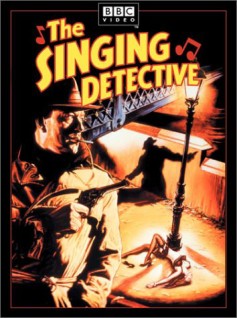
Back in the 1980s, I watched a BBC series about a hack writer suffering from a debilitating skin condition. He refuses pain medication, leading to hallucinations involving characters from his childhood, from the pulp detective novels he writes, the hospital staff, and others. Sometime during each episode the characters break out into song.
Sounds weird, right? Goofy, dumb, ridiculous.
I thought it was great, and several scenes from the series have stuck with me over the years. If you were to ask me what is the most beautiful word in the English language, I would immediately say “Elbow”, because that is what the main character says. There is a scene where the same character describes sitting at the top of the stairs as a boy, after he is supposed to be asleep in bed, and listening to his parents talk and sing downstairs in the living room. I don’t remember if I ever did that, but it’s an evocative image.
I wanted to watch it again, but couldn’t find it on any streaming service.
Somehow (I don’t want to know how) a friend found it and sent me some mkv files, so I was able to watch the whole thing all over again.
I think I liked it even better this time. If you’re looking for something a little, ok a lot, different: check it out.
Göbekli Tepe
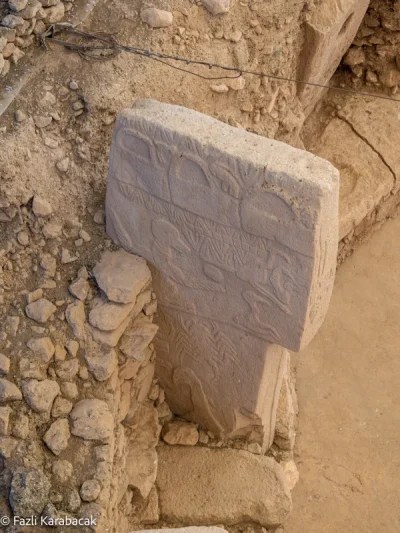
I don’t have a bucket list of places that I want to visit before I die. In a perfect world, I’d go anywhere and everywhere. But there is one particular place that intrigues me more than any other: Göbekli Tepe, in Turkey.
It is the oldest megalithic structure ever discovered; older than Stonehenge by about 7 thousand years and the pyramids in Egypt by even more. It is older even than Ġgantija, which we visited in Malta last year.
The Göbekli Tepe site wasn’t excavated until the 1990s, but its very existence has forced scientists to reconsider the timeline of human civilization. At the time of its construction, agriculture hadn’t been developed and hunter-gatherer communities weren’t believed to be sufficiently well organized to build monumental structures like Göbekli Tepe. And yet, they did.
But that’s not all; there is something even more curious. Carved into these ancient stone structures are images and symbols of uncertain significance. Some researchers believe that they represent an astronomical “timestamp” documenting a cataclysmic meteor impact that triggered the Younger Dryas, a period of rapid and dramatic global cooling.
This is very much a minority view, on two fronts. The idea that a comet impact triggered the change in climate is not accepted by most of the scientific community. And the idea that images carved at Göbekli Tepe record such an event has also been rejected, notably by the archeologists leading the excavation of the site. The relationship between the two camps is testy. The leading proponent of the astronomical interpretation of Göbekli Tepe is Martin Sweatman, who is professor at the University of Edinburgh, with a PhD in theoretical physics, not an archeologist.
Here is a link to a primer on his ideas:
Göbekli Tepe and the Origins of Science
I think it is a plausible and ingenious interpretation of the imagery, but others think it is speculative pseudo-scientific bunk. 🤷🏻
And that’s why I’d like to have a look for myself.
Cry me a river
When the man stepped right up to the microphone, he said exactly what I was thinking. In the 1970s, everyone my age knew who Julie London was. She was “Dixie McCall”, the feisty nurse on the TV series, “Emergency”. We/I didn’t know that she was also a very talented singer of some renown.
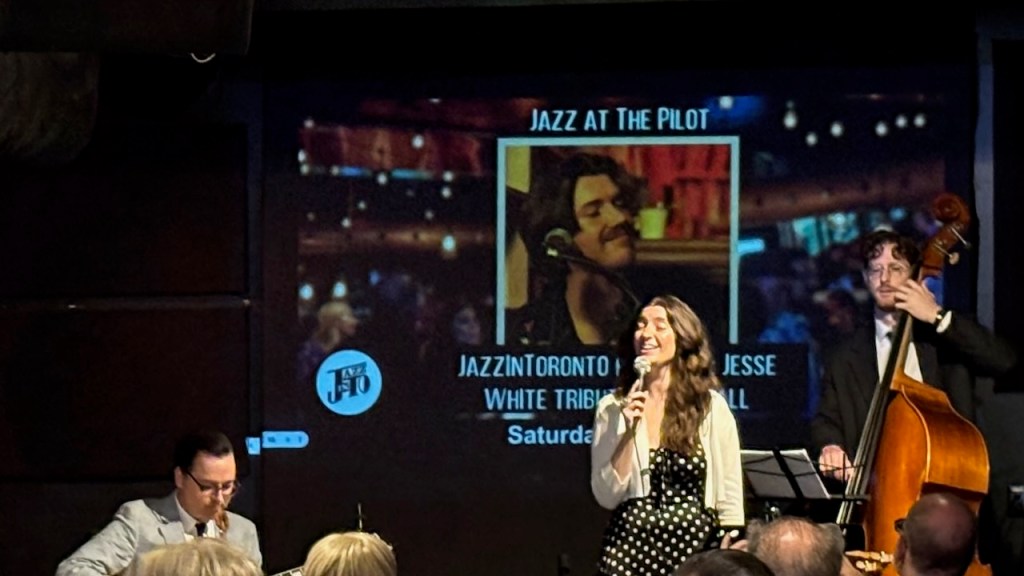
Recently, JazzinTO featured an afternoon concert of local singer Ale Nuñez singing the Julie London songbook. So we decided to go, and meet some friends there.
The venue was The Pilot, a bar in the Yorkville area with a decades long history. Compared to some of the other dumps we’ve been to recently, it’s pretty nice. The decor is supposed to reflect an aviation theme, with sheet metal panels and rivets, but to me felt more like a submarine.
Nuñez is a talented young singer, and did a more than credible job of invoking London’s memory. The set list was long, and didn’t allow for much improvisation by her supporting band.
Cry me a river
I should care
I’m in the mood for love
I’m glad there is you
Can’t help lovin that man of mine
Cole porter song?
It never entered my mind
‘S wonderful
No moon at all
Gone with the wind
Blue Moon
What is this thing called love
How long has this been going on
You stepped out of a dream
Hot toddy
I guess I’ll have to change my plans
Little white lies
Moments like this
Hot toddy (again)
Instrumental support was provided by Ben Bishop on guitar and Jonathan Meyer on double bass. Both are well regarded Toronto musicians, but I wasn’t overly impressed. Bishop was given more opportunity to show his stuff, but I found it lacking emotion and creativity. It was pretty unadventurous, I thought. Everyone at our table agreed that the sound mix for Meyer’s bass was poor. It was hard to hear him, and his solos were pretty short but only kind of sweet.
The show was part of a weekend long mini-festival organized by the people at jazzintoronto.ca. Tickets were $20, and it was definitely worth it (supporting live music nearly always is). The Pilot’s second floor was nearly full at the start of the show, but dwindled considerably over the afternoon. By the end, most tables were empty. That might have been a factor in the somewhat flat performances by the band.
PS: the header image this month is a bunny, Taken at the reservoir behind our home in Toronto.

fun stuff. I definitely listened to parents dinner parties from top of the stairs. Will look for this show.
Myf and debated seeing that site in Turkey / Türkıye last year. Sounds amazing. We figured we would go back.
I think there is a structural aversion to error in archaeology. Look at L’Anse aux Meadows. Or the weirdly defensive controversy on pre Clovis human settlement of North America.
I don’t know if you’re aware that Dennis Potter had the same skin condition as the character in the Singing Detective, so there is a lot of autobiography in that work.
There are a couple of other series with lip-synced standards that I’d recommend checking out (Pennies from Heaven and Lipstick on your Collar), as well as Dreamchild, a film about an aged Alice Hargreaves being tormented by her memories of being the inspiration for Lewis Carroll’s Alice stories.
While he was dying from pancreatic cancer, he gave a final interview https://youtu.be/OjTnojZQ–0?si=06S53I9bPErraEaf with Melvyn Bragg about his life’s work and final projects he was hoping to complete. Potter is smoking and taking swigs of liquid morphine throughout. Everyone should watch this.
>
Thanks David. I had read about Potter’s illness, but had never seen the interview. I’m about 15 minutes in and you’re right, it is terrific.