This website is 100% human. No AI is used at all. But I did ask Claude.ai to review everything I have written and generate a “google-style” review. Here’s what it came up with. I’ll take it.
★★★★☆ (4/5) — b r a n n a n . o r g
A retiree’s personal blog, built around a monthly “3 Things” series. The writing is sharper than you’d expect: honest live-music criticism, genuinely moving obituaries, and one standout piece — “A Bonhill Story,” a well-researched family-history mystery. Some months are thin, and the reference points (jazz, Scottish history, world travel) skew toward an older, well-traveled reader. Good if you like unpretentious personal essays; not for everyone.
This month’s offering includes: 1) a surprising map of Toronto, 2) 1976 was a great year for jazz (or was it?), and 3) a weekly recap from a thoughtful guy driving his camper-van around the UK.
This is currently my favourite map1
It shows the change in population in Toronto neighbourhoods during the 50 years from 1971 to 2021. During that period, the total population of Toronto grew by a third, from 2.1 million to 2.8 million. If you left Toronto in 1971 and returned in 2021, you wouldn’t recognize the place. At least, you wouldn’t recognize downtown which is now filled with office towers and high-rise condo apartments. If you go outside this area, not much has changed. In fact, the largely residential areas surrounding the downtown core, actually experienced a decline in population at the same time as the total population was booming.
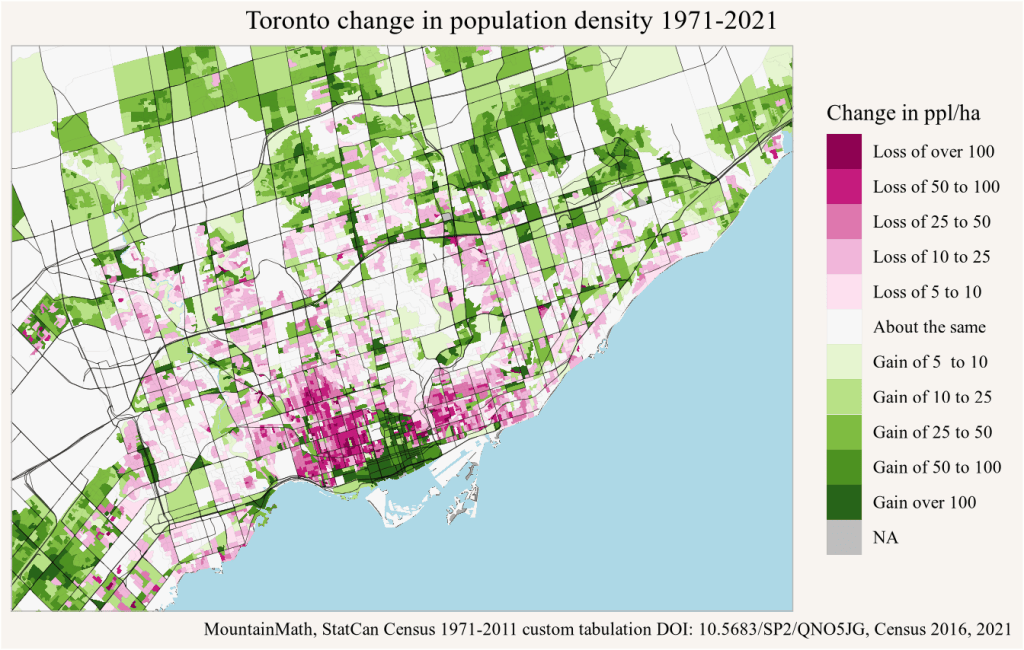
In my favourite map, the areas that are growing appear in various shades of green, and the areas with fewer people are in pinkish-purple. You can see a ring of green around the city, where new suburban neighbourhoods were built, and a deep green central core, where condo construction was concentrated. But between them is a zone of pinkish purple.
What’s going on is a huge planning failure. The parts of the city with declining population, leafy neighbourhoods with single and semi-detached homes, are frozen in amber. Largely, I suspect, due to empty-nest baby-boomers who want to remain in the homes where they raised families. Their kids are long gone, their schools and recreation centres are empty, but the parents remain2.
The worst part is that there has been very little new housing built in these areas, despite a local, regional and national crisis in home affordability. Any time a proposal to build slightly more dense housing, say a 4-plex, is put forward, the neighbours rally to argue that it is the wrong kind of development in the wrong place3.
Because of the housing choices made by my generation, others are forced to choose between living outside the city, often with very long commutes or living within a small central core in very pricey and very small condos. It isn’t a rational way for a city to grow.
What I Missed in 1976
It’s been 50 years since I graduated from high school. Later this month, I will attend a reunion with many of my previous classmates and in honour of this momentous occasion, I decided to listen to the highest rated jazz music from that year.
I wasn’t a jazz fan in 1976; my knowledge was restricted to the few popular jazz songs that managed to cross-over to the pop/rock world (e.g. George Benson) and a little bit from a few jazz records in my parent’s collection (Johnny Mathis, Ella Fitzgerald etc.). I was much more into progressive rock at the time and so much of the Rolling Stone list of Top Rated Jazz Records of 1976 was new to me.
50 years later, here is what I thought:
1. Sam Rivers & Dave Holland – Dave Holland & Sam Rivers, Vol. 1
This collaboration is almost all Sam Rivers; very little Dave Holland, which is a shame. Very improvisational. At times the music just disappears, in a kind of Buddhist way. I mean, the music is still there but your attention is elsewhere. Is that what they wanted? Who knows.
There are only 2 long tracks on this record, and I listened to the first: Hoo boy. That 1970s jazz fusion thing was pretty much indistinguishable from the worst excesses of 1970s guitar rock. It is balls-to-the-wall all-out funkalicious. If that is your type of thing, you will love this. Me? One listen was more than enough.
3. Sam Rivers & Dave Holland – Sam Rivers / Dave Holland Vol. 2
Although they were released separately, it seems strange for Rolling Stone to consider Vol.1 and Vol 2. as two separate entries in the “best of” list. It’s Rivers & Holland again, this time Rivers is on flute and piano, rather than sax. Holland’s bass is a bit more noticeable here, which is good. But Rivers is less engaging, which is bad. If I had to pick one, I couldn’t. Not really enamoured with either.
4. Charlie Haden – “Closeness” Duets
Lovely. These duets have stood up well. CH with Keith Jarrett, with Ornette Coleman, with Alice Coltrane and with Paul Motian. In each case there is a delicate balance with Haden’s bass and the partner’s piano/sax/harp/percussion.
Is this “jazz”? Maybe, but it is quintessentially Tom Waits. Gravelly voice. Stories of drunks and strippers and losers. What more could you want? 50 years later, this is still great.
6. Dave Brubeck – All the Things We Are
Quintessentially Dave Brubeck. The kind of music that middle age hipsters would go to hear at a supper club. Brubeck and co all brush cuts and skinny ties. Squeaky clean – these are not your heroin addicted jazz die-hards. The music is pleasant, great background to the tinkling of martini glasses and puffs of cigarette smoke. Pleasant, but not distinctive. Each song much like the others.
7. Dizzy Gillespie & Machito – Afro-Cuban Jazz Moods
Yeah, OK. Competent, but 7th best in 1976? Must have been a slow year.
8. John Abercrombie & Ralph Towner – Sargasso Sea
Finally, an album I have heard of, and might even have listened to at some point in the past 50 years. Abercrombie and Towner, both guitarists, play together, without any other support. Actually, it feels to me more like they are playing beside each other, not really together. Each does his own thing, and it is good, virtuosic even. But jazz is truly great when artists communicate with each other, which I didn’t hear much of here. Both have done much better work.
9. John Coltrane & Wilbur Harden – Countdown
Coltrane died of liver cancer at the age of 40 on July 17, 1967, so it is a bit of a surprise to see him appearing on a best album list from 1976. Unless someone unearthed some hidden gems, this seems misplaced. AllMusic says it is “just another hard-bop jam session from the 1950s”, and I couldn’t find the album on Tidal. So, I didn’t bother to listen to this one.
10. Niels-Henning Ørsted Pedersen & Sam Jones – Double Bass
Double bass is one of my favourite jazz instruments, and this album has two (2) double bass players, so it is no surprise that it was a hit with me. Two bass players, a guitar, drums and bit of tambourine for good measure. It is light as a feather or a soap bubble. I just love it. Joyful. Wonderful.
Shall we continue?
I was only going to comment on Rolling Stone’s top 10, but there are some other recordings on the list that I found interesting. So I kept going. Check the footnotes for more4.
A guy with a camera and a camper-van
Every Friday, Andy Marshall shares his thoughts about architecture, time, and the relationship between them.
He has the enviable “job” of photographing a variety of Britain’s many ancient buildings, mostly churches. Often, he finds that the buildings provide occasions for reflection that most of us don’t have the time or opportunity to experience. I look forward to his weekly thoughts. If nothing else, it’s a chance to see things through a different lens.
More here…. Genius Loci
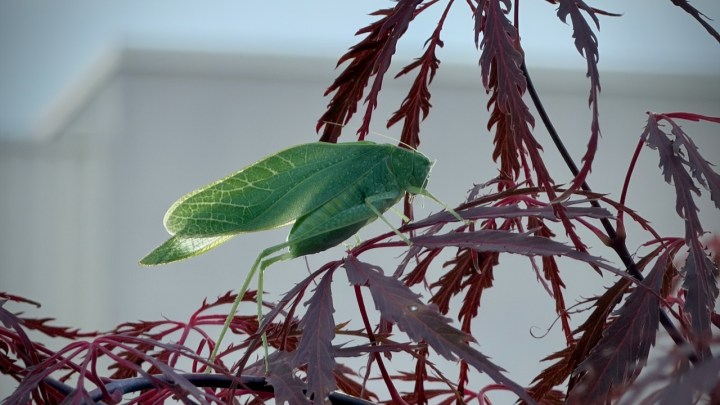
PS: the header image this month is a bug. It’s a katydid that visited HVW and me on our terrace for several evenings in September. We live on the eighth floor and this is the only one we’ve seen here, so think he might have been swept up to us by a storm.
- Yes, I have a favourite map; doesn’t everyone? ↩︎
- This is currently a “housing” problem, but unless things change dramatically the demographic trends suggest that it will become a public health issue in the coming years. Boomers health will decline: they will lose the ability to drive, they will become more prone to falls on the street, on the stairs in their houses and, very often, in their bathrooms. Lloyd Alter, a Toronto planner, has been warning of this for years. (See for example: How Dangerous Design in our cities and homes is killing our olders ) ↩︎
- For a recent example, see here… Toronto homeowners neighbouring duplex dispute ↩︎
- More 1976 Jazz stuff:
11. Jaco Pastorius – Jaco Pastorius
I’ve known about this album forever, but never listened to it end-to-end. It holds up very well, and is a testament to Pastorius’s massive talent. Sad that he died so young. There are many strong tracks in divergent styles, but Okonkolé Y Trompa is a favourite, scored for an unusual combination of electric bass, French horn, and percussion.
12. Weather Report – Black Market
“Weather Report is generally regarded as the greatest jazz fusion band of all time, with the biggest jazz hit (“Birdland”) from the best jazz fusion album (1977’s Heavy Weather)” (Source: AllMusic ). When it comes to their music, I am a dilettante. Most of this record is just meh, IMHO. Neither jazz nor rock nor world music, but occupying a curiously bland spot in the middle. But, but…. sometime in the past 50 years 3 live tracks have been added and the last one, a version of “Black Market” that gives Wayne Shorter a chance to shine, is a banger. Jaco Pastorius is on this one too.
13. Pat Metheny – Bright Size Life
I never owned this album, but I am a huge fan and bought many of Metheny’s subsequent releases. This one, his first, has the foundations of what would become his distinctive style, but Lyle Mays (1953-2020) hadn’t yet joined and his absence shows how much his piano and synthesizer later added to the sound. Despite including Jaco Pastorius’s (1951-1981) wildly inventive electric bass guitar to the background, it is not Metheny’s best work, by a long shot. But it’s a good, solid album. The title track is my favourite.
14. Gato Barbieri – Caliente!
Yech. Smooth seventies saxophone, with overbearing orchestral overtones.
15. Ron Carter – Yellow & Green
I liked this quite a lot. I looked it up, and it doesn’t get much respect in the pantheon of Ron Carter fans, but I liked it. ↩︎
